

No louvre manufacturer will guarantee that their louvres will exclude water under all conditions of wind and rain. Whilst mechanical means can be provided to help combat water penetration, the first consideration should be keeping the air velocity through the louvre to a minimum.
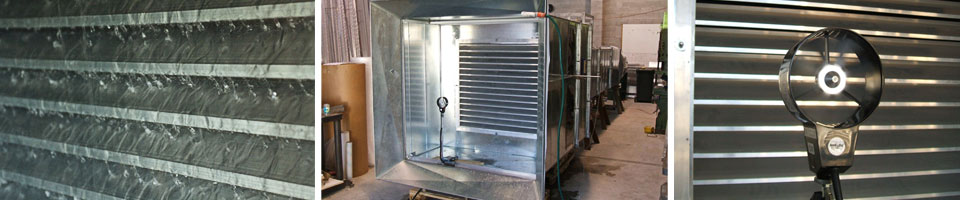
Water penetration tests were conducted using a combined rain droplet and wetted wall method (a rain droplet only method will understate the water penetration results). The combined method simulates more realistically the actual operating conditions a louvre will experience when installed.
A rainfall in excess of 100 mm/hr was used. For comparison, a 1 in 50 year storm event is 70mmlhr, whilst 'heavy rainfall' is 6 mm/hr (NIWA Climate Data Bank, Aug 2000).
The table below shows two velocity points. The first is the free area velocity at which occasional water droplets passed through the louvre. The second free area velocity is when significant water droplets passed through the louvre.
| Louvre Type | Occasional Penetration Free Area Velocity (m/s) |
Significant Penetration Free Area Velocity (m/s) |
| WPL50 Weather Resistant Louvre | 4.1 | 4.7 |
| WPL100 Weather Resistant louvre | 4.8 | 5.4 |
| WPL100 Vertical Louvre | 4.9 | 5.4 |
| EXH100(1) Louvres (Exhaust) | 1.4 | 2.1 |
(1) Water penetration is not normally a factor to be considered with louvres optimised and used exclusively for exhaust conditions.